El Estudio OPPERA: Claves para Comprender el Dolor Orofacial Crónico.Revisión de literatura.
DOI:
https://doi.org/10.31984/oactiva.v11i3.1229Palabras clave:
Disfunción de la ATM, dolor orofacial, mialgia, variantes genéticas, sensibilización del SNC, estrés.Resumen
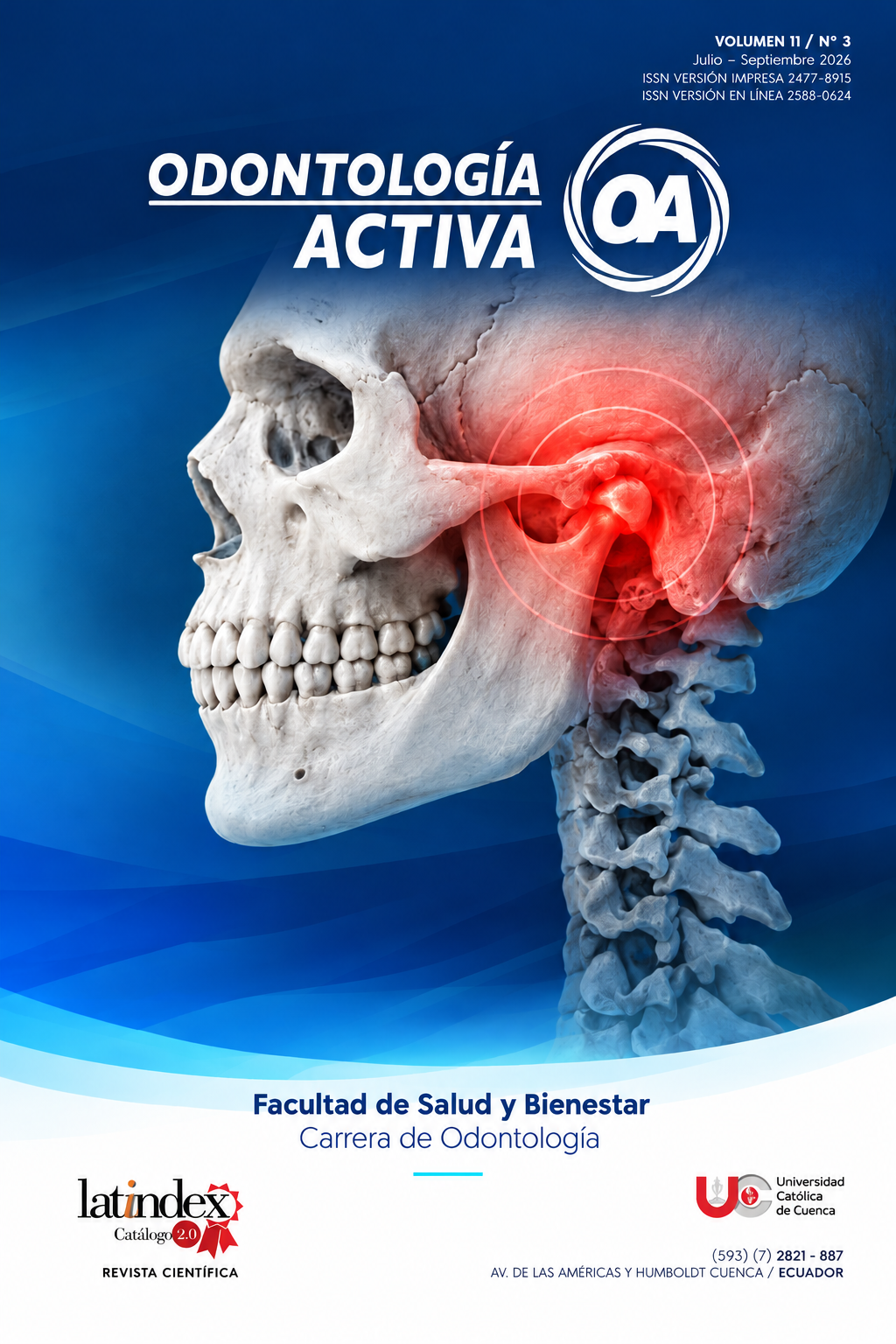
Los trastornos temporomandibulares son una causa común de dolor orofacial crónico que afecta funciones como la masticación y el habla. El estudio OPPERA, iniciado en 2005 con más de 3.000 participantes, abordó su origen multifactorial desde una perspectiva biopsicosocial y genética. Se ha Identificado una mayor prevalencia en mujeres jóvenes, asociada a factores hormonales y emocionales como el estrés y la ansiedad. También evidenció la presencia de sensibilización central como mecanismo del dolor crónico, y relacionó variantes genéticas como COMT y OPRM1 con mayor sensibilidad al dolor. Sus hallazgos promueven un enfoque clínico integral y personalizado para el diagnóstico y tratamiento de los TTM. Además, el estudio destaca la alta incidencia de comportamientos parafuncionales como el bruxismo y la coexistencia de dolor musculoesquelético en otras regiones del cuerpo, lo que refuerza la visión de los TTM como parte de un espectro más amplio de disfunciones musculoesqueléticas crónicas.
Descargas
Citas
Dubner R, Slade GD, Ohrbach R, Greenspan JD, Fillingim RB, Bair E, et al. Painful Temporomandibular Disorder: Decade of Discovery from OPPERA Studies. Vol. 95, Journal of Dental Research. SAGE Publications Inc.; 2016. p. 1084–92. doi: 10.1177/0022034516653743.
Noblecilla Gutiérrez HN, Avegno Quiroz MA. Prevalencia de trastornos temporomandibulares en pacientes total y parcialmente edéntulos de la clínica UCSG- A 2017. Medicina (B Aires). 2019 Mar 7;23(1):42–6. doi: https://doi.org/10.23878/medicina.v23i1.987
AlZarea BK. Temporomandibular disorders (TMD) in edentulous patients: a review and proposed classification. J Clin Diagn Res. 2015 Apr;9(4):ZE06–ZE09. doi: 10.7860/JCDR/2015/13535.5826.
Peck CC, Goulet JP, Lobbezoo F, Schiffman EL, Alstergren P, Anderson GC, et al. Expanding the Taxonomy of the Diagnostic Criteria for Temporomandibular Disorders. J Oral Rehabil. 2014;41(1):2–23. doi: 10.1111/joor.12132.
Dubner R, Slade GD, Ohrbach R, Greenspan JD, Fillingim RB, Bair E, et al. Painful Temporomandibular Disorder: Decade of Discovery from OPPERA Studies. Vol. 95, Journal of Dental Research. SAGE Publications Inc.; 2016. p. 1084–92. https://pmc.ncbi.nlm.nih.gov/articles/PMC5004239/
Chisnoiu AM, Picos AM, Popa S, Chisnoiu PD, Lascu L, Picos A, et al. Factors involved in the etiology of temporomandibular disorders - a literature review. Vol. 88, Clujul Medical; 2015. p. 473–8.
https://pmc.ncbi.nlm.nih.gov/articles/PMC4689239/pdf/cm-88-473.pdf
Gaynor SM, Fillingim RB, Zolnoun DA, Greenspan JD, Maixner W, Slade GD, et al.
Association of hormonal contraceptive use with headache and temporomandibular pain: The OPPERA study. J Oral Facial Pain Headache. 2021;35(2):105–112. https://files.jofph.com/files/article/20231201-16/pdf/ofph_35_2_Gaynor_2727_p105.pdf
AlSahman L, Althobaiti F, Alotaibi N, Alhassan R, Alshahrani H, AlKhaldi H, et al.
Association of stress, anxiety and depression with temporomandibular disorders in young adults – a systematic review.
Arch Med Sci. 2023;19(4):1050–60. https://www.archivesofmedicalscience.com/pdf-171955-113743?filename=Covariation+of.pdf
Yamagata K, Sugimura M, Yoshida M, Nakayama Y, Okumura Y, Nakagawa T, et al.
Estrogens exacerbate nociceptive pain via up-regulation of TRPV1 and ANO1 in trigeminal primary neurons of female rats.
Endocrinology. 2016;157(11):4309–17. https://academic.oup.com/endo/article-pdf/157/11/4309/20218279/endo4309.pdf
Hashem G, Zhang Q, Hayami T, Chen J, Wang W, Kapila S.
Relaxin and β-estradiol modulate targeted matrix degradation in specific synovial joint fibrocartilages: progesterone prevents matrix loss. Arthritis Res Ther. 2006;8(4): R98. https://arthritis-research.biomedcentral.com/track/pdf/10.1186/ar1978
Greenspan JD, Slade GD, Bair E, Dubner R, Fillingim RB, Ohrbach R, et al. Pain sensitivity and autonomic factors associated with development of TMD: The OPPERA prospective cohort study. J Pain. 2013 Dec;14(12 Suppl):T63–T74.e6. doi:10.1016/j.jpain.2013.06.007.
Wieckiewicz M, Pihut M, Topolska-Siedzik J, Sierpińska T, El-Sheikh AM, Grychowska N. Somatosensory abnormalities in painful temporomandibular disorders: a cross-sectional study using quantitative sensory testing. J Clin Med. 2024;13(6):1395. doi:10.3390/jcm13061395.
Gaynor SM, Fillingim RB, Zolnoun DA, Greenspan JD, Maixner W, Slade GD, et al. Association of hormonal contraceptive use with headache and temporomandibular pain: The OPPERA study. J Oral Facial Pain Headache. 2021;35(2):105–112. doi:10.11607/ofph.2727.
Fillingim RB, Ohrbach R, Greenspan JD, Knott C, Dubner R, Bair E, et al. Psychological factors associated with development of TMD: The OPPERA prospective cohort study. J Pain. 2021;22(12):T75–T90. doi:10.1016/j.jpain.2021.06.009.
Slade GD, Ohrbach R, Greenspan JD, Fillingim RB, Bair E, Dubner R, et al. Painful temporomandibular disorder: Decade of discovery from OPPERA studies. J Dent Res. 2021;100(10):1084–1092. doi:10.1177/00220345211012345.
Maixner W, Fillingim RB, Williams DA, Smith SB, Slade GD. Overlapping chronic pain conditions: implications for diagnosis and classification. J Pain. 2016;17(9 Suppl):T93–T107. doi:10.1016/j.jpain.2016.06.002.
Kim HK, Chung K-m, Xing J, Kim HY, Youn D-h. The Trigeminal Sensory System and Orofacial Pain. Int J Mol Sci. 2024;25(20):11306. doi:10.3390/ijms252011306
AlSahman L, Althobaiti F, Alotaibi N, Alhassan R, Alshahrani H, AlKhaldi H, et al.Association of stress, anxiety and depression with temporomandibular disorders in young adults – a systematic review.
Arch Med Sci. 2023;19(4):1050–60.
doi:10.5114/aoms/171955
Smith SB, Mir E, Bair E, Slade GD, Dubner R, Fillingim RB, et al. Genetic variants associated with development of TMD and its intermediate phenotypes: The genetic architecture of TMD in the OPPERA prospective cohort study. J Pain. 2013 Dec;14(12 Suppl):T91–T101.e1–3. doi:10.1016/j.jpain.2013.09.004.
Wu X, Li Z, Cui Y, Yan Z, Lu T, Cui S.
Neurodevelopmental disorders as a risk factor for temporomandibular disorder: evidence from Mendelian randomization studies. Front Genet. 2024;15:1365596. doi:10.3389/fgene.2024.1365596
Ferreira NdR, Marto CMM, de Oliveira AT, Rodrigues MJ, DosSantos MF.
Development of core outcome sets for clinical trials in temporomandibular disorders: A study protocol. PLoS One. 2022;17(4):e0267722. doi:10.1371/journal.pone.0267722.
Descargas
Publicado
Cómo citar
Número
Sección
Licencia
Derechos de autor 2026 Odontología Activa Revista Científica

Esta obra está bajo una licencia internacional Creative Commons Atribución-NoComercial-CompartirIgual 4.0.
Se autoriza la reproducción total y parcial, y la citación del material que aparece en la revista, siempre y cuando se indique de manera explícita: nombre de la revista, nombre del autor(es), año, volumen, número y páginas del artículo fuente. Las ideas y afirmaciones consignadas por los autores están bajo su responsabilidad y no interpretan necesariamente las opiniones y políticas del Consejo Editorial de la Revista OActiva ni de la Universidad Católica de Cuenca.
La Revista OActiva utiliza la Licencia Creative Commons de Reconocimeinto-NoComercial-CompartirIgual 4.0, que es la siguiente: CC BY-NC-SA 4.0 Internacional.